How to Launch Private-Label Whitening Toothpaste Tablets: A Step-by-Step Guide

Consumers look for oral-care products that fit their routines, preferences, and lifestyles. Whitening toothpaste tablets offer brands a way to bring something different to the everyday brushing routine.
But before adding them to your product range, look beyond the format itself. Consider what your customers want, how the formulation performs, and what would make your product stand out from others on the market.
Here are six considerations to work through before making whitening toothpaste tablets part of your portfolio. The goal is to build an offer that fits your customers and your business, then prepare a clear path to launch.
1. Understand What Your Customers Want
Before developing a new product, identify the needs it should address. Some consumers prioritize convenience, while others look for specific ingredients, familiar flavors, or whitening benefits as part of their daily routine.
Whitening toothpaste tablets offer a compact alternative to traditional toothpaste. Their pre-portioned format also makes them convenient for travel, work, and everyday use.
For brands, the opportunity lies in identifying the right audience. A travel-focused brand might prioritize portability, while a whitening-focused brand may emphasize whitening benefits and everyday usability.
Understanding these preferences helps you build a product with a clear purpose rather than simply adding another item to your range.
2. Understand the Ingredients Behind the Formulation
The ingredients in a whitening toothpaste tablet influence its intended benefits, taste, and overall performance. Understanding their roles can help you assess whether a formulation aligns with your brand’s positioning.
Here are some ingredients commonly considered in whitening toothpaste tablets and the roles they may play. Their inclusion alone does not establish a finished product’s benefits.
- Hydrogen peroxide and PVP: Hydrogen peroxide is used in whitening formulations. In some tablets, PVP is used in a complex with hydrogen peroxide. The product’s concentration, intended use and supporting data matter more than an ingredient name alone.
- Hydroxyapatite: A mineral used in oral-care products, including formulations with enamel-related positioning. Any associated benefit claims should be supported for the finished product.
- Calcium carbonate and sodium bicarbonate: Ingredients used in some toothpaste tablets for cleaning and other formulation functions.
- Xylitol and stevia leaf extract: Sweetening ingredients used to balance flavor without adding sugar.
- Natural peppermint flavor and menthol: Ingredients that contribute to flavor and a cooling sensation during use.
- Sodium cocoyl glycinate: A surfactant that helps with cleansing and foam formation.
- Microcrystalline cellulose and magnesium stearate: Ingredients used to support tablet structure and manufacturing performance.
- Zinc citrate and silica: Ingredients that may serve oral-care, processing or texture-related functions depending on the formula.
An ingredient list does not prove how well a product performs. Brands should review the formulation, ingredient quantities, compatibility, and supporting evidence for its claims.
For more background on tablet ingredients, read our guide to toothpaste tablet ingredients.
3. Evaluate the Formulation Beyond Its Ingredients
A product may look promising on paper but still fall short during everyday use. Sample evaluation is an important step in assessing its suitability for your brand.
Pay attention to the following factors:
- Taste and texture: Does the product offer a pleasant brushing experience?
- Foaming: Does the formulation produce an acceptable level of foam for its intended use?
- Tablet hardness: Can the tablets withstand normal handling, storage, and transportation?
- Disintegration: Does the tablet break down appropriately during use?
- Moisture protection: Is the packaging suitable for protecting the product from humidity?
- Stability and shelf life: Is supporting documentation available to establish how the product performs over time?
- Consumer acceptance: Do people in your target audience find the product convenient and easy to use?
For whitening products, it is also important to review relevant performance testing and the evidence supporting the proposed claims. These checks help you make a more informed decision before moving into production.
For products containing hydrogen peroxide, confirm that the directions, cautions, intended audience, and proposed marketing claims have been reviewed for the markets where the product will be sold.
4. What Makes a Whitening Toothpaste Tablet Stand Out?
A new product needs a clear reason to earn a place in the market. While the format itself may attract attention, the overall product experience helps distinguish one brand from another.
Consider these areas when developing your product strategy.
Flavor and sensory experience
Taste, texture, and foaming can influence whether customers enjoy using a product regularly. Flavor preferences also vary across markets, making them worth your consideration during product development.
Ingredient positioning
Some brands may focus on hydrogen peroxide-based whitening, while others may prioritize different oral-care ingredients. Choose a positioning that reflects the actual formulation and can be supported by appropriate evidence.
Packaging and presentation
Packaging affects shelf appeal, storage, and portability. Compact containers may suit travel-oriented products, while premium cartons or distinctive designs may support an elevated brand identity.
Target audience
A product designed for everyday use may need different messaging from one positioned around travel convenience or a particular ingredient preference. Define your audience before deciding which features to emphasize.
For example, Oralmega’s whitening toothpaste tablets use a hydrogen peroxide-based formulation described as PeroxiCore Whitening Technology. The product also includes hydroxyapatite and comes in a Triple Mint, non-SLS format. These details offer a starting point for explaining the format and intended product experience.
5. Does the Product Fit Your Existing Portfolio?
Before expanding your range, consider how toothpaste tablets would complement your current products.
For example, a brand selling private-label teeth whitening strips could introduce whitening toothpaste tablets as a separate everyday oral-care offering. A brand focused on travel essentials might explore the compact format as part of a portable hygiene range.
You should also assess the competitive landscape. Look at the products already available, their price points, packaging, claims, and target audiences. This can help you identify gaps and avoid entering the market with an offering that has no clear distinction.
6. Questions to Ask Before Choosing a Private-Label Manufacturer
The manufacturing partner you choose can affect product quality, customization options, and the overall launch process. Before making a decision, clarify the practical details.
Can the product be customized?
Ask about logo placement, labels, available packaging options, flavor choices, and whether formulation changes are offered. It is important to distinguish a ready-to-brand product from a separately quoted custom-development project.
What are the minimum order quantities?
Minimum order quantities (MOQs) influence the initial investment and inventory commitment. Choose an arrangement that fits your budget and expected demand.
As one practical example, Oralmega offers online orders of 50 or 100 jars for its current whitening toothpaste tablets, with volume pricing available for larger quantities.
Can you evaluate samples first?
Request samples to assess taste, texture, tablet performance, and packaging suitability before finalizing your decision. Oralmega offers samples to qualified business buyers; shipping and handling may apply.
What documentation is available?
Ask for relevant quality documentation, stability information, shelf-life support, and evidence for product claims. Requirements will depend on the markets where you intend to sell.
What are the production and packaging requirements?
Clarify lead times, packaging specifications, customization costs, and any requirements for artwork approval. These details help you plan the launch more accurately.
For Oralmega’s standard online whitening tablet product, customers can submit branding after checkout and review a digital label proof before production.
A clear understanding of these factors helps you assess whether a manufacturer is suitable for your business.
From Sample Evaluation to Product Launch
Once you have identified a suitable formulation and manufacturing partner, follow a structured process to prepare for launch.
- Evaluate samples: Assess the product against your quality standards and user-experience expectations.
- Review documentation: Check formulation details, stability information, and supporting evidence for product claims.
- Finalize positioning: Define the target audience, product benefits, and brand messaging.
- Approve packaging: Confirm the design, materials, labeling, and moisture-protection requirements.
- Confirm commercial details: Review MOQs, pricing, production timelines, and inventory requirements.
- Prepare for launch: Ensure the product and its claims meet the applicable requirements in your target market.
Taking these steps before production can reduce avoidable changes and help you make decisions with greater confidence.
What Launching with Oralmega Looks Like
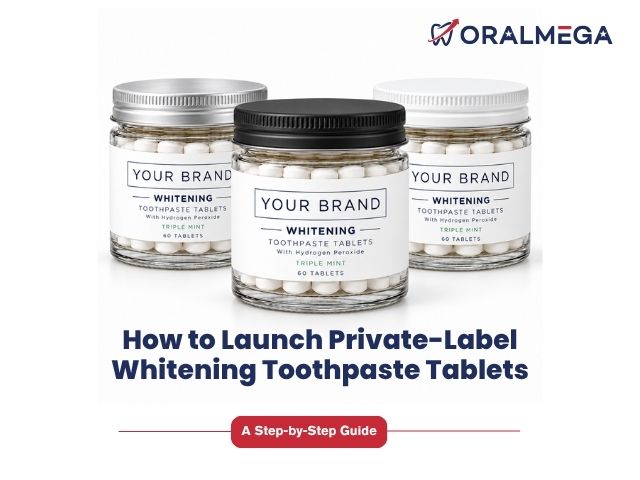
Oralmega offers a ready-to-brand private-label whitening toothpaste tablet product in 60-tablet glass jars. The formula uses hydrogen peroxide-based PeroxiCore Whitening Technology, includes hydroxyapatite, and has a Triple Mint flavor with a non-SLS formulation. Each jar can carry a custom label, with a choice of white, black, or silver lid. The tablets are blended, pressed, labeled and packaged in Tonawanda, New York, using international components.
Businesses can order 50 or 100 jars online, provide branding details after checkout, and approve a digital label proof before production. For higher quantities or additional packaging, contact Oralmega to discuss pricing and specifications.
Build a Product That Fits Your Brand
Whitening toothpaste tablets can offer oral-care brands a new way to approach everyday brushing. Their potential, however, depends on more than the format alone.
The right product should meet a clear consumer need, deliver a satisfactory user experience, and fit your brand’s positioning. Instead of following a trend without a clear strategy, focus on building a product that gives your customers a practical reason to choose your brand.
Explore Your Private-Label Options
Ready to explore whitening toothpaste tablets under your own brand? View Oralmega’s whitening toothpaste tablets to see product details and order options, request samples to evaluate the range, or contact our team to discuss larger orders and packaging requirements.